Where the Alexander Mosaic is, and why you can't see it
Are you choosing how to get in?At the ticket office, a ticket costs €20 with no booking fee. What you find online adds an app, a guide, or skip-the-line access.
Compare the six optionsWhat the museum says, verbatim
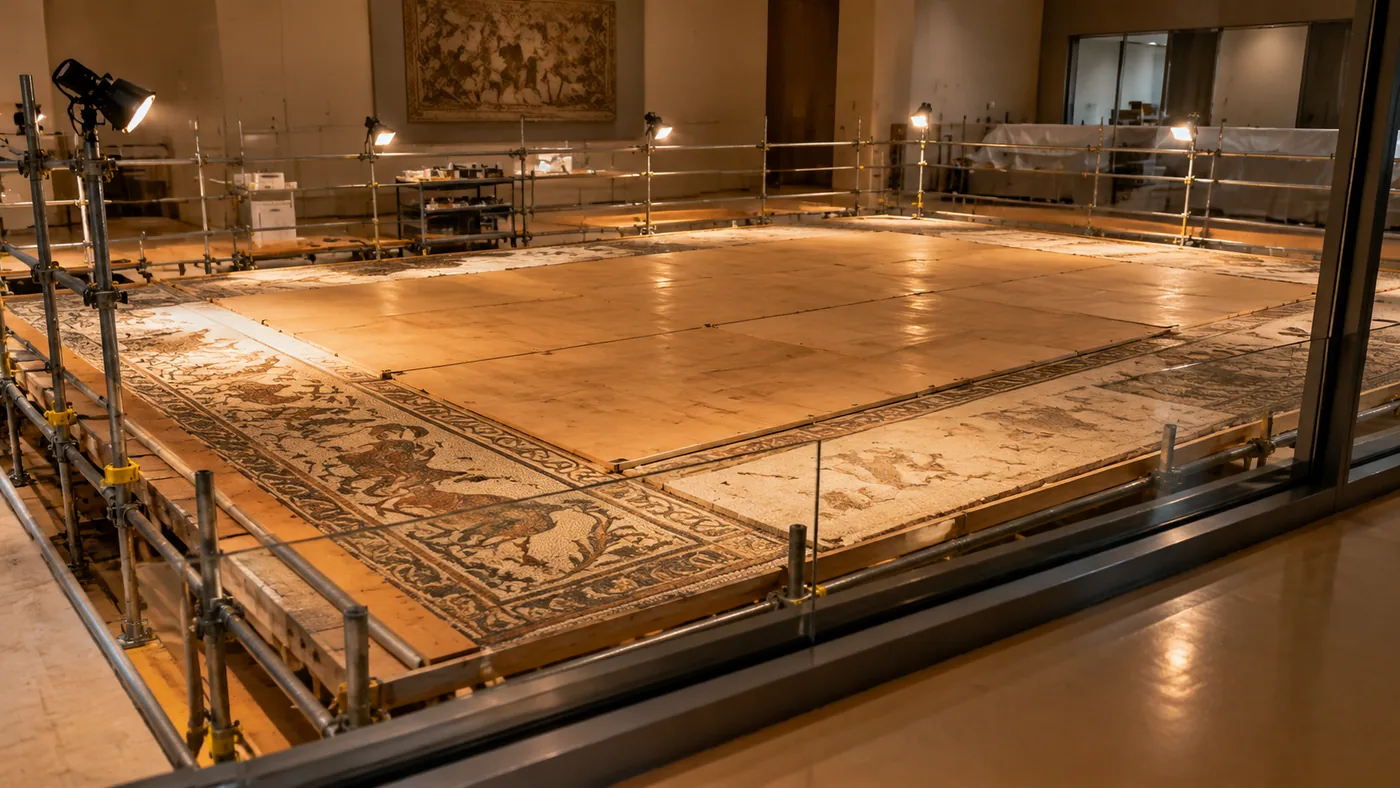
On its homepage: “The Alexander the Great Mosaic is undergoing extraordinary restoration work, and is therefore not visible. The public can observe the worksite activities thanks to two distinct viewing points specially set up in the Mosaics Collection”. So you're looking at the worksite, not the mosaic. And the two viewing points are inside a room that closes from 16 September, and remains closed until 30 November 2026.
There's a complication worth knowing before you go: the official page for the Mosaics Collection is out of date and still presents the Alexander Mosaic as the highlight of the visit, without a word about the restoration. The museum's website contradicts itself. Between the two pages, the homepage is correct, and that's why this page exists. The same applies to the other sections: what's closed now I keep on a separate page, with a link to the official opening plan.
Restoration stages, by date
- 2021 — extraordinary restoration work begins.
- Late October 2023 — the work is flipped face down. The museum's words: “the work will be carried out… on the rear surface of the artwork… the mosaic tesserae… will not be visible because they are covered by the protective wooden planking”.
- 1 November 2023 — the worksite opens to the public with the two viewing points.
- 3 July 2024 — the second executive phase begins.
- 16 September 2026 — the entire Mosaics Collection closes, until 30 November. The two viewing points also disappear.
No completion date has been published. I'm not publishing one either.
The object, because it's worth knowing anyway
It measures 5.82 by 3.13 metres, inventory 10020, and the museum describes it as composed of “more than a million tesserae”. It comes from the House of the Faun in Pompeii, where it was found in 1831, and arrived in Naples on November 16, 1844 on a cart pulled by sixteen oxen. In 1916 Vittorio Spinazzola had it walled vertically onto an iron frame, and the oxidation of that frame is the main cause of the damage currently being treated. A Pompeian mosaic that survived an eruption and seventeen centuries underground has been damaged by the way we hung it.
If the Alexander Mosaic was the reason for your trip, change your reason before you leave, not when you're standing in front of the room. The Gabinetto Segreto in room 65, the frescoes with the “Flora” and Terentius Neo, the bronzes from the Villa dei Papiri, and the Plastico di Pompei in room 96 are open and more than enough to justify your day.
The final tally is simple: the museum's most famous piece cannot be seen, and no one tells you that before you buy your ticket. The rest of the museum still holds up, and if you're still deciding, the honest answer about whether it's worth it is here. A live guide, two hours, starts at €42 at the time of writing and is the only one who can rearrange your visit on the spot when a room is closed; the ticket alone, at the box office, remains €20 with zero pre-sale fee.
 Live guide
Naples: National Archaeological Museum Guided Tour
 Best seller
Naples: National Archaeological Museum Ticket and Audio App
 Private
Naples: Private Guided Tour of the National Archaeological Museum
Frequently asked questions
Where is the Alexander Mosaic located?
At the National Archaeological Museum of Naples, in the Mosaics collection on the first floor, but it is not visible: it has been under restoration since 2021 and since the end of October 2023 it has been flipped face down for work on the back. It comes from the House of the Faun in Pompeii, where it was found in 1831.
Can you see the restoration site?
Yes, until September 15, 2026, from two viewing windows within the Mosaics collection. From September 16 to November 30, 2026, that collection closes, and with it, the two viewing windows also disappear.
When will the Alexander Mosaic be visible again?
The museum has not published any reopening date, so there isn't one to report. It is known that the second executive phase of the restoration began on July 3, 2024, and that the work concerns the back of the artwork. In the meantime, this is what you actually see.