What to see at the Naples Archaeological Museum, room by room
Are you choosing how to get in?At the ticket office, the ticket costs €20 with no booking fee. What you find online adds an app, a guide, or skip-the-line access.
Compare the six optionsFirst of all: this list has a date on it
The opening statuses you read below are those from the window published by the museum for the period 7 August – 21 September 2026. MANN republishes the collection opening plan every few weeks, and in the meantime, a fixed notice remains on every page of its website: “The Museum is undergoing extraordinary re-fitting works for some collections and energy efficiency improvements… some exhibition sections or parts of them are temporarily closed to the public”. Do not copy room numbers from anywhere, not even from here, without checking the day's plan. I have listed all closures on a page I keep updated.
Ground floor: the Farnese Collection, but not all of it
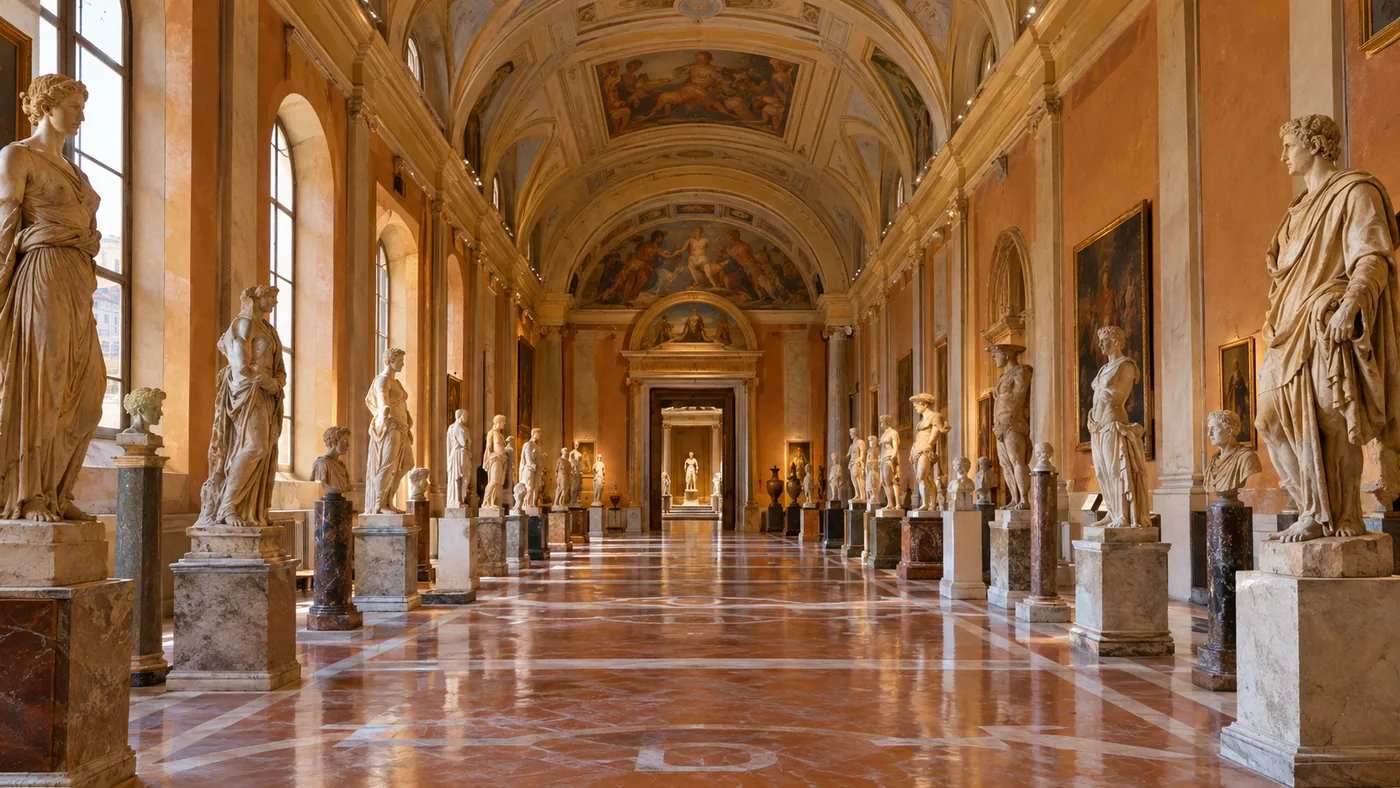
The ground floor houses the Greco-Roman statuary that arrived in Naples with the Bourbons. The museum describes it with a caution worth repeating: “perhaps the most famous among the Roman collections of antiquities”. However, the opening plan guarantees only rooms 1-7 and 25-29, and adds that the Farnese Statuary is “partially closed to the public until further notice”.
You'll quickly realise: the Toro Farnese is in room 16 and theErcole Farnese in room 11. Neither of these is within the guaranteed section. It's not a restoration of the works — it's the PNRR construction site for replacing the lighting, “MANN and the environment: energy efficiency for a green museum” — but for visitors, the result is the same: the room might be closed. And here the museum contradicts itself: the official printable map lists the Farnese Collection as “rooms 1-8, 11-16, 25-29,” without a word about closures. Anyone who trusts the map will arrive in front of the Toro and find a panel.
The Toro is 3.70 m high, between 2.95 and 3.00 m wide, carved from a single block of marble (inv. 6002), and comes from the Baths of Caracalla. The Ercole is high 3.17 m (inv. 6001), was found in 1546, bears the signature of Glykon of Athens, the original is attributed to Lysippus, and the legs were integrated by Carlo Albacini in 1787. Within the guaranteed section, there are still major pieces: theAfrodite Callipigia (inv. 6020) is in room 25, which means it's open.
Le Gemme Farnese, with the Tazza Farnese, are in rooms 9-10 and are open only on Saturdays and Sundays, 9 AM–7:30 PM. If the Tazza is your reason for coming, the day of the week matters more than the time.
Level -1: The Egyptian collection
Rooms XVII–XXIII, open, and it's one of the museum's three air-conditioned rooms. It was formed between 1817 and 1821 and the museum presents it as “the second most important in Italy after the Egyptian Museum of Turin” — that's their phrase, and I'm quoting it as theirs. It's also the only collection with its own booking rule: groups of 10 to 30 people must book, free of charge, and each slot lasts a maximum of 30 minutes.
A warning that will save you money: the Egyptian collection is closed on free admission days. If you've chosen the first Sunday of the month, this section won't be available. The trap of free days is explained here.
First floor: the mosaics that aren't there, and the Gabinetto Segreto
The first floor houses the mosaics collection, the Gabinetto Segreto, and the Numismatics. Let's start with the bad news: the Alexander Mosaic is not visible, it has been under restoration since 2021, and the two viewing windows for the work are inside the mosaics collection, which closes from September 16 to November 30, 2026. During that period, neither the mosaic nor the restoration site nor the rest of the gallery will be accessible. The full story, with verified dates, is here.
Il Gabinetto Segreto on the other hand, is open, it's in room 65, it's included in the ticket and does not require any separate booking: no separate ticket, no time slot. The museum's current regulations do not contain any age limit for this room; the only age rule is the general one, “children under 12 must be accompanied by an adult”. Inside there are “about 250 erotic artifacts”, almost all from Pompeii and Herculaneum: Pan and goat (inv. 27709, from the Villa dei Papiri), the Venus in a bikini (inv. 152798), Leda and the swan (inv. 27695). The room was reopened by order of Garibaldi on September 11, 1860, reclosed by Pais in 1901, liberalized in 1971, and permanently opened to the public only in 2000. This also closes on free days.
La Numismatics, rooms 51-56, has no guaranteed opening. The museum's words for rooms of this type are: “opening cannot be guaranteed; in case of specific interest, visitors are invited to ask for information directly at the ticket office before entering the Museum”. Asking at the ticket office takes thirty seconds.
Second floor: frescoes, Isis, the bronzes, and the sundial
The second floor is the part of the museum that best withstands closures, and it's also the one the museum recommends visiting in the morning or late afternoon when it's hot.
- Frescoes — rooms 67-75, 77 and 78. The Sacrifice of Iphigenia (inv. 9112), the so-called “Flora” from Stabiae (inv. 8834, room 77), Terentius Neo and his wife e Sappho in room 78, the Brawl in the Amphitheater (inv. 112222). The Blue Vase isn't here: it's in room 85, among the objects of daily life, and every year someone looks for it among the frescoes and doesn't find it.
- Temple of Isis — rooms 79-82 and 84. Excavated since 1764, it was the first cult building brought to light in Pompeii.
- Villa dei Papiri — rooms 114-117, and pay attention to the opening hours: it's only open 10:00–18:20. The villa was 250 m from the sea in Herculaneum, buried under 27 m, excavated between 1750 and 1764 under Karl Weber, and it's named for “over 1,800 carbonized papyrus scrolls”. The museum states that “the sculptures from the Villa dei Papiri constitute the largest collection of Roman-era bronzes that has come down to us”. The Runners and the Dancers are in room 117; then theAthena Promachos, the Drunken Satyr, the Pseudo-Seneca. This area is also air-conditioned.
- Salone della Meridiana — the vault was frescoed by Pietro Bardellino in 1781; the sundial is from 1791, designed by Pompeo Schiantarelli based on the calculations of the astronomer Giuseppe Casella, and the museum says it is “still perfectly functional today”. The Bourbon Library was here from 1783 to 1926; theFarnese Atlas (inv. 6374) is here.
- Plastico di Pompei — room 96. Inaugurated in 1879, conceived by Giuseppe Fiorelli, first executed by Felice Padiglione, in cork and at a 1:100 scale, with paper floors and mosaics reproduced tessera by tessera. If you saw Pompeii the day before, look at it: it's the only place from which you can see the whole city at once.
On the first floor, the elevators “only serve the wing of the Museum in which they are located”: to go from one wing to another, you have to return to the ground floor. On the second floor, however, you cross the Salone della Meridiana and pass through. If you have difficulty walking, do the second floor in one go.
The two sections you might not find
La Magna Grecia (rooms 130-143) and the upper floors of Prehistory and Protohistory have no guaranteed opening; the first level of Prehistory, however, is not a problem. To enter Magna Grecia, you need flat, heel-less shoes and shoe covers, which are provided by staff and are free. Magna Grecia is also one of the three sections that remain closed on free admission days.
La Epigraphic Collection, rooms 151-157 on level -2, is closed. And the museum states in black and white the clause that it's better to read before and not after: “This exceptional event cannot result in a refund of the ticket already purchased”Nobody will give you your money back because a room was closed.
Heat closes rooms midday
This is the detail that surprises visitors arriving at noon in July. Due to the heat protocol, some rooms may close between 12:30 PM and 4:00 PM, and the museum itself suggests visiting the first floor in the morning or late afternoon. The three air-conditioned spaces are the Egyptian collection, the Villa dei Papiri, and the exhibition Parthenope. The Siren and the City, which is on the second floor, is included in the ticket and has been extended until September 21, 2026.
With a guide, things change, and it's worth mentioning
In a museum with 125 rooms and approximately 18,000 works on display, with few captions and some rooms that may be closed, having someone decide what to look at makes a real difference. The two-hour guided tour starts from €42 as of this writing, with free cancellation up to 24 hours in advance. It's not mandatory: at the ticket office, the ticket costs €20 and the pre-sale fee is zero, so entering on your own remains the cheapest option. The full price list, item by item, is on the tickets page.
The six entry options
“Starting from” prices read on GetYourGuide on September 14, 2026. They fluctuate, and none of these replaces the day's opening plan.
 Live guide
Naples: National Archaeological Museum Guided Tour
 Best seller
Naples: National Archaeological Museum Ticket and Audio App
 Priority entrance
Naples: National Archaeological Museum with Digital Guide
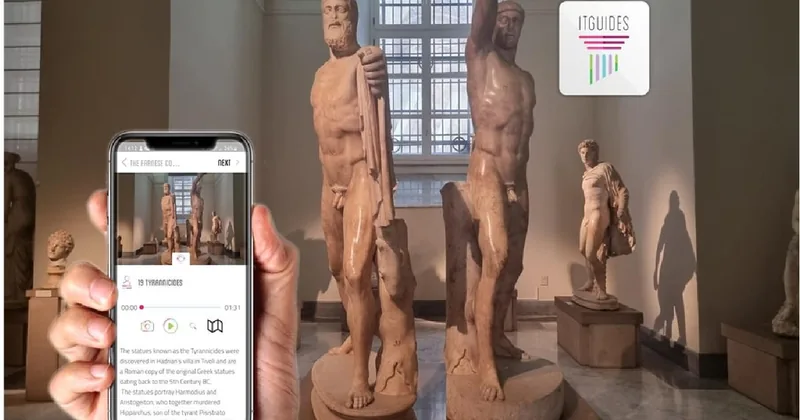 Cheapest
Naples: National Archaeological Museum Audio Guide
 Private
Naples: Private Guided Tour of the National Archaeological Museum
 City pass
Campania: Artecard 3–7 days or Gold/Lite 365
Frequently asked questions
What absolutely must you see at the National Archaeological Museum of Naples?
The things that are open and certain are the Gabinetto Segreto in room 65, the Egyptian collection on level -1, the Pompeian frescoes with “Flora” and Terenzio Neo, the Temple of Isis, the bronzes from the Villa dei Papiri, and the Plastico di Pompei in room 96. The Alexander Mosaic is not, and has not been since 2021.
Can you see the Toro Farnese?
It's not guaranteed. The Toro is in room 16 and the Ercole in room 11, and the museum's opening plan only guarantees rooms 1-7 and 25-29 of the Collezione Farnese, until further notice. It's not a restoration of the sculptures: it's work on the lighting. The current status of the rooms is here.
Is the Gabinetto Segreto included in the ticket?
Yes. It's in room 65 on the first floor, it's included with admission and doesn't require a separate ticket or booking. The only exception is on free admission days, when it remains closed along with the Egyptian and Magna Grecia collections.
How many rooms does the Naples Archaeological Museum have?
One hundred and twenty-five, with about 18,000 works on display according to the museum's service quality charter. Not all of them are open at the same time, and the official map has a 19-numbered-stop route with no times indicated: how long it actually takes is another matter.
How long does the visit take if I want to see everything?
The museum doesn't publish any recommended duration, and the closed rooms change the count every few weeks. Its only references are the 85-minute audio guide for 90 artifacts and the 75-minute official guided tour. The rest is an estimate, and should be stated as such.